
Building Strength with hEDS for Better Joint Stability

Living with hypermobile Ehlers-Danlos Syndrome can make the body feel unpredictable. A shoulder may slip during sleep. Knees may ache after errands. The neck, hips, wrists, or ankles may feel like they need constant guarding.
Muscle strength cannot change the connective tissue differences that come with hEDS, but it can give the joints better support. For many people, strength work becomes one of the most useful tools for safer movement, less fear around activity, and a steadier daily routine.
People with hEDS should work with a knowledgeable healthcare professional when starting or changing an exercise plan.

Why strength matters when joints are hypermobile
In hEDS, connective tissue is more flexible than usual. Ligaments and joint capsules may not give the same firm feedback or restraint that they do in less hypermobile bodies. That can lead to joint instability, pain, fatigue, and a higher risk of sprains, strains, subluxations, or dislocations.
Muscles help fill that gap.
Strong muscles act like a living brace. They help guide joints through motion and limit extra movement at the end of range. This matters because many injuries in hEDS happen when a joint moves too far, too fast, or without enough control.
Strength also supports proprioception, the body’s sense of where it is in space. Many people with hEDS report poor body awareness, clumsiness, or “not knowing where a joint is” unless they look at it. Slow, controlled strengthening can improve that feedback over time.
A physical therapist familiar with hypermobility will often focus less on big, flashy movements and more on control, alignment, and repeatable comfort. The goal is not to force the body into a standard fitness routine. The goal is to build a body that feels more reliable.
How stronger muscles can change daily life
Strength training for hEDS is not only about exercise. It can affect ordinary moments that often drain energy.
Getting out of a chair, carrying groceries, climbing stairs, washing hair, cooking dinner, or standing in line all require strength and endurance. When muscles fatigue quickly, joints may take more load. That can increase pain and make the body feel unstable by the end of the day. Better strength can support daily life in several ways:
Less joint guarding
When muscles support joints better, the body may not need to brace as hard during every task.
More stamina for routine activities
Stronger hips, legs, shoulders, and trunk muscles can make walking, standing, cleaning, and errands less exhausting.
Greater confidence with movement
A stable joint often feels safer. That confidence can reduce fear around normal activity.
Better posture tolerance
Strength through the back, core, and hips can make sitting and standing easier, especially during school, work, or caregiving tasks.
Fewer flare triggers
Carefully paced strength work may reduce the chance that small daily loads become painful overloads.
Many people with hEDS describe progress as subtle at first. A person may notice they can unload the dishwasher without shoulder pain, walk farther without ankle rolling, or sit through a meal without needing to constantly shift position. These small changes matter because they add up to more independence.
Strength training tips that fit hEDS bodies
The best strengthening plan for hEDS is usually gradual, specific, and flexible. Some people tolerate resistance well. Others need to begin with very small movements, short sessions, or exercises done lying down.
A common rule is to train control before load. If a joint wobbles, locks, shifts, or moves into an extreme range, the exercise may need to be adjusted.
Start with joint-friendly basics
These exercises are often used in hEDS-friendly programs, but they should be matched to each person’s symptoms and medical history:
Isometric holds
These involve tightening a muscle without moving the joint much. Examples include gentle quad sets, glute squeezes, wall presses, or shoulder blade squeezes.
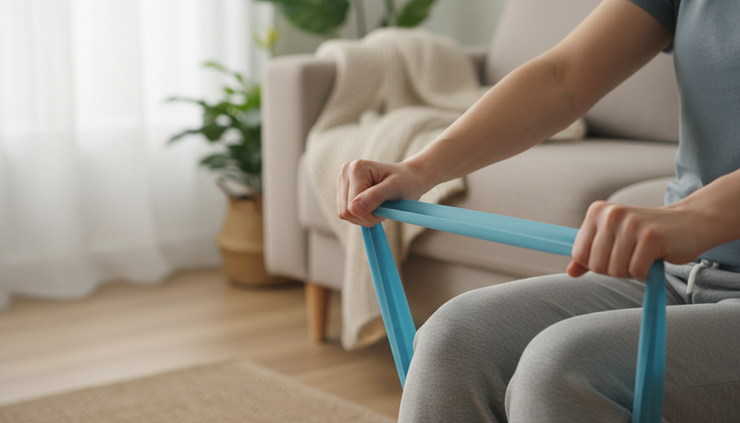
Resistance band work
Light bands can help strengthen shoulders, hips, and upper back with lower impact.
Closed-chain exercises
These keep the hand or foot in contact with a surface, such as wall push-ups, mini squats to a chair, or supported step-ups.
Core and trunk stability
Dead bugs, modified side planks, pelvic tilts, or gentle bird dogs may help support the spine and hips when done with good form.
Balance and proprioception drills
Weight shifts, supported single-leg stands, and slow marching can train joint awareness.
Stay away from end-range habits
Many people with hEDS can “hang” into their joints without realizing it. Knees may lock backward. Elbows may hyperextend during push-ups. Hips may sink into extreme positions during stretches.
Strength work should usually happen in a safe middle range, not at the far edge of flexibility. Mirrors, video feedback, tactile cues, or guidance from a physical therapist can help.
Use the right dose
More is not always better with hEDS. A helpful plan may begin with just a few exercises, low resistance, and plenty of rest. Soreness that settles within a day can be normal. Sharp pain, joint slipping, swelling, nerve symptoms, dizziness, or a flare that lasts several days means the plan needs review.
Pacing helps. Some people do best with short sessions several times per week instead of one long workout. Others need to split exercises into tiny sets during the day.

Clinicians who understand hEDS usually look beyond muscle strength alone. They may assess pain patterns, joint instability, fatigue, balance, posture, breathing, autonomic symptoms, and how the person responds after activity.
A physical therapist may focus on:
Building strength around the most unstable joints
Improving movement quality during daily tasks
Teaching safe alignment without rigid overcorrection
Grading activity so the nervous system and tissues can adapt
Helping the person tell the difference between effort, fatigue, and warning pain
Occupational therapists can also help by adjusting daily tasks. For example, they may suggest joint-protective cooking tools, pacing plans, seating changes, or ways to reduce hand strain.
A supportive care team does not push through symptoms at any cost. It helps the person build capacity while respecting the body’s limits. That kind of progress is worth taking seriously. For hEDS, better strength often shows up as more trust in the body.

Building strength is a long-term support system
Strength training with hEDS should feel patient, steady, and personalized. The aim is not to chase intense workouts or compare progress with anyone else. The aim is to create better support for joints, improve daily function, and make movement feel safer.
A good starting point is simple: choose one or two gentle exercises, stay out of end range, track how the body responds, and ask for help from a clinician who understands hypermobility. Small, consistent gains can become meaningful changes in pain, stability, confidence, and quality of life.


Comments