
hEDS and Artery Dissections: What Patients and Doctors Need to Know

A sudden, severe headache. New neck pain after a minor strain. Chest pain that feels unlike anything you have felt before. For most people, these symptoms have many possible causes. For someone with a connective tissue disorder, they may raise a more specific concern: could an artery have torn?
That question comes up often in hypermobile Ehlers-Danlos syndrome, or hEDS. The answer is reassuring in one way and serious in another. Artery dissections appear to be uncommon in hEDS, especially compared with vascular Ehlers-Danlos syndrome. Still, they can happen, and awareness can shorten the path to diagnosis when symptoms are real and time sensitive.
Sudden chest pain, stroke-like symptoms, fainting, or the “worst headache” of someone’s life needs urgent evaluation. No matter what the cause!

Common symptoms of hEDS include joint instability, frequent sprains or subluxations, chronic pain, fatigue, easy bruising, headaches, gastrointestinal symptoms, dizziness on standing, and autonomic problems such as postural orthostatic tachycardia syndrome.
The key point is that hEDS can affect much more than flexibility. Still, the risk is not the same as vascular EDS, the EDS subtype most strongly linked to arterial rupture and dissection.

What artery dissections are and why they matter
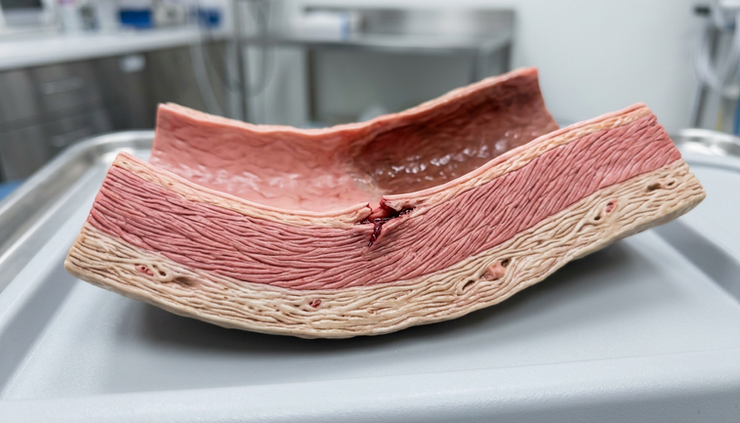
An artery dissection happens when a tear forms in the inner lining of an artery. Blood can enter the wall of the vessel and split its layers. This may narrow the artery, block blood flow, form a clot, or weaken the vessel wall.
The risks depend on the artery involved.
A cervical artery dissection in the carotid or vertebral artery can lead to stroke, especially in younger adults. An aortic dissection can be life-threatening because the aorta carries blood from the heart to the body. A spontaneous coronary artery dissection, often called SCAD, can cause a heart attack when it affects the arteries that feed the heart.
Possible warning symptoms include:
Sudden severe chest, back, neck, or abdominal pain
New neurological symptoms, such as weakness, numbness, trouble speaking, vision loss, or facial droop
A sudden severe headache, especially if unusual for the person
Fainting, shortness of breath, or symptoms of heart attack
One-sided neck pain or headache after minor trauma or strain
These symptoms do not prove a dissection. They do mean that clinicians should think broadly, especially if the person has a known connective tissue disorder, a family history of aneurysm or dissection, or features that suggest vascular EDS.
What studies suggest about prevalence in hEDS
Good data are limited because hEDS has changed definitions over time, and many older studies grouped EDS types together. That matters because vascular EDS carries a much higher arterial risk than hEDS. If those groups are mixed, the risk estimate for hEDS can look higher than it truly is.
Recent hEDS and hypermobility spectrum disorder studies suggest that major arterial events are not common and are often in patients with co-occurring migraine headaches.
Evidence source | What it found | Why it matters |
Studies using modern hEDS criteria | Aortic root dilation is reported in a minority of patients, often mild | This is more common than dissection, but it still supports cardiovascular review in selected patients |
A 2020 cohort of adults with hEDS or hypermobility spectrum disorder | Extra-aortic arterial events, including cervical artery dissection and SCAD, were reported in small numbers | The events occurred, but prevalence was low |
Older EDS literature | Arterial rupture and dissection were more prominent when EDS types were mixed | Some older risk estimates may reflect undiagnosed vascular EDS rather than hEDS |
In one published adult cohort that included people with hEDS and hypermobility spectrum disorders, arterial events outside the aorta were uncommon, with only a few reported cases of cervical artery dissection or SCAD. Other cardiovascular findings, such as mitral valve prolapse or mild aortic dilation, appeared more often than dissections.
That pattern fits the clinical distinction specialists often make vascular fragility is a defining concern in vascular EDS and a more rare one in hEDS.. Yet a rare event can still be real for the person experiencing it.
What experts emphasize in practice
Medical geneticists and cardiovascular specialists tend to focus on two points.
First, a person diagnosed with hEDS who has an unexplained arterial dissection deserves a careful reassessment. That may include review of the diagnosis, family history, physical features, and genetic testing for conditions known to cause arterial fragility, such as vascular EDS, Loeys-Dietz syndrome, Marfan syndrome, and familial thoracic aortic aneurysm syndromes.
Second, doctors should not dismiss symptoms simply because hEDS is often described as “nonvascular.” Low prevalence does not mean no risk.
The Ehlers-Danlos Society and specialty clinics commonly stress accurate subtype diagnosis for this reason. Management, screening, family counseling, and emergency planning can differ sharply between hEDS and vascular EDS.
For many people with hEDS, routine full-body vascular imaging is not recommended without specific risk factors. But targeted evaluation may be appropriate when there is a personal or family history of aneurysm, dissection, or unusual bruising and tissue fragility.

Why awareness and early diagnosis matter
Artery dissections are time-sensitive. Stroke care, heart attack care, blood pressure control, surgical consultation, and vascular imaging may all depend on early recognition.
For patients, awareness means knowing which symptoms should not wait. It also means keeping a concise medical history available, including diagnoses, medications, allergies, prior imaging, and family history.
For clinicians, awareness means asking the next question. Is the hEDS diagnosis the only diagnosis present? Or is the patient diagnosed with another disorder that causes issues with vasculature. Does the symptom pattern fit a possible dissection? Would CT angiography, MRI angiography, ultrasound, or specialist referral change care?
The most balanced message is this: people with hEDS should not live in fear of artery dissections, but they should not have serious vascular symptoms minimized. The best care sits between panic and dismissal. It uses accurate diagnosis, clear emergency signs, and a willingness to investigate when the story does not fit the usual pattern.


Comments